Tuesday, 20 January 2026
Saturday, 17 January 2026
Everyone goes naked in uniformity.

I do think, implicitly, this defense of the sari is posed in contrast to the veil (hijab, etc.). The idea that Hindu traditionalism is compatible with sexual liberation —although risible— seems to be taken seriously when juxtaposed to even more ridiculous claims made by defenders of Islam.
There is no unity in belief: there is unity in its opposite. We are divided by religion and united by nihilism. We are not united by the clothes we wear, but by the clothes we refuse to wear. We are not made one by symbols, nor by abstract (symbolic) reasoning, but by the breaking of symbols: mental nudity.

Monday, 12 January 2026
Iran: I am not opposed to civil war, I am opposed to pretending that peaceful protest can accomplish the same things as a civil war...
[A viewer writes in, responding to the short video above:]
It has actually been reported that the number is now closer to 6,000 [peaceful protestors killed in the streets]. My people have had enough. We cannot stop now. If we do, the revenge this regime will unleash would be far more devastating. What would be the point anyway? To stop only to die of starvation?
Iran will never be Syria. The majority of Iranians are done with Islam. They see anything associated with Islam as a symbol of their colonizers, which explains the mosque burnings. We also have a clear alternative: Crown Prince Reza Pahlavi, who over the past 45 years has consistently preached the same message through his advocacy, that power should come from the people. His actions have perfectly reflected the ideology he has promoted all these years. As he gained more popularity, he began taking more decisive actions. This has led to what we see today: people chanting his name, calling for his return, and now hearing him give direct guidance on reclaiming our beloved Iran.
I used to watch your content frequently a long time ago, and since I am somewhat familiar with your political views, I thought I would let you know about one of the most popular chants on the streets right now. It symbolizes that people have learned their lesson from everything that went wrong in 1979.
“Death to the three corrupt: the Mullah, the Leftist, and the Mojahed.”
These are the three forces that ruined Iran through the fusion of Islamism and Communism, the Red and Black alliance. It mirrors what is happening today in the West.
Lastly, I want to end with a story from the Shahnameh by Ferdowsi, the greatest work of Persian literature ever written. Simorgh, also known as the Phoenix in Persian mythology, must die and turn into ashes so that she can rise again stronger than before. Sometimes, that is the only way.
For years, I heard many Iranians, myself included at times, criticize Mohammad Reza Shah Pahlavi. We said he should have been a dictator, as people wrongly labeled him, and that instead of leaving the country and refusing to rule through fear or turn against his own people, he should have crushed the protests. But with everything that has unfolded, I cannot help but wonder if it was necessary to suffer for 47 years so that Iranians could finally move on from a religion that colonized them 1,400 years ago. It is a tragic idea to accept, but perhaps this was the Phoenix story of the Iranian people.
May you come and visit a free Iran sooner rather than later.
—Javid Shah
—————
Quote, "The majority of Iranians are done with Islam." You're telling me that more than 50% of the population of Iran is atheist (not Buddhist, presumably) and willing to fight a war against Islam? You're telling me that more than 45 million Iranians (out of 90 million or more) are anti-Islamic? When you go out in the countryside and talk to the poor: the majority of those people are willing to work with Israel and with America against their own government… for this reason? Really? Does that sound falsifiable to you?
—————
@a-bas-le-ciel I mean, the best poll we have comes from the GAMAAN Institute and was conducted in 2020 under the title “Iranians’ Attitudes Toward Religion.” It showed that 60 percent of Iranians no longer identify as Muslim. They are not atheists, even though I wish they were. Most still believe in a God, just not a religious one. This poll was conducted before the Mahsa Amini uprising and the current revolution, so I would wager that the number is even higher today. I want to reiterate that I am not claiming the poll is perfect, but it is the best evidence we currently have, aside from the Islamic Republic’s own fabricated statistics, where people are automatically labeled Shia in their passports at birth. I would post the link, but YouTube would likely block my comment, so just search the title along with the word GAMAAN and it will come up.
Other polls also show a significant rise in parents choosing Iranian names over Arabic names for their children, as well as a growing abandonment of Islamic traditions in favor of Iranian ones such as Nowruz, the Iranian New Year, over the past 47 years. All of these trends point in the same direction.
Aside from that, I was born and lived in Iran for 18 years before moving to Canada. I can speak from personal experience, and in my opinion, once the regime falls, Iran is about to become the true capital of what many would call Islamophobia. We are all anxiously waiting to see how this plays out, especially within the diaspora.
To answer your question directly, Iranians do not need to fight a war against Islam. My point is that I genuinely believe the fight is already over and that most people have already moved on. I emphasize the word most because there will still be a portion of the population that remains Muslim, but they will be a minority.
Lastly, yes, I truly believe there is no force Iranians despise more intensely than the Islamic Republic. I think the majority of the population is willing to work with Israel and the United States. I have followed Iranian politics for years, and believe me when I say that Trump and Netanyahu have an unsettling number of devoted fans in Iran, more than you would even find in Israel or America. The political views that emerge from Iran after the fall of this regime are going to shock the West. I understand how extreme this may sound to someone not closely following Iranian politics, but maybe in a few months or a year I will comment on one of your videos and say, “I told you so.”
—————
Re: "It showed that 60 percent of Iranians no longer identify as Muslim." I think you are profoundly misinterpreting the situation —and you may well be gamble with your own life on the basis of this misinterpretation. Re: "I have followed Iranian politics for years, and believe me when I say that Trump and Netanyahu have an unsettling number of devoted fans in Iran, more than you would even find in Israel or America." We will see precisely how many (or how few) are now willing to prove this in a civil war: it is one thing to passively say you support Caesar and another thing to fight and die for the future of an illusion.
—————
@a-bas-le-ciel I saw that you made a post about my comment. Thank you for taking the time to respond. I genuinely appreciated much of what you had to say about nihilism, as that was the kind of content I originally followed you for. It always bothered me that whenever someone says they are a nihilist, the immediate response is, “Oh, so you must be depressed.” Society as a whole seems unable to recognize the clear distinction between atheism and nihilism, even though, as you pointed out, nihilism rejects all beliefs, not just belief in a deity. I also appreciated your discussion of how nihilism can be used as a tool or framework to improve one’s life. In addition, I enjoyed your content on debunking and discussing determinism, especially the salt crystal analogy you used.
The reason I specifically referenced that particular chant is that, if I remember correctly, you grew up in a communist household and you have a profound dislike for that ideology. I used that chant because I thought you would be able to relate to the struggle of my people who are suffering under the very ideas you oppose on a personal level, ideas that have devastated my beloved Iran for the past 47 years.
I do not think I am misrepresenting the situation. Iranians are extremely patriotic, and many of us are willing to die for Iran. I do not know if you can fully grasp what I am feeling, but there is a burning jealousy inside me that I am not in Iran right now, fighting alongside my compatriots to reclaim the land of Cyrus the Great. I was 11 years old when I left my house without my parents knowing to participate in the Green Movement protests. Those protests also turned violent. If I could press a button and be there right now, I would do it without hesitation.
You also said that many people are willing to die for what you call an illusion. First of all, it is not an illusion, or if you believe it is, that claim needs to be demonstrated. Iran is not Iraq, Afghanistan, or Syria. The culture, population, and collective will of the people are fundamentally different. Even if I grant that point for the sake of argument, I do not think you fully grasp how dire the situation in Iran truly is. People have been dying for years as a result of this government’s policies and incompetence. Fewer than ten percent of the population supports the regime, and there are polls that reflect this reality as well.
People are dying because they cannot access the medicine they need. They are dying due to poor road management and car accidents. They are dying from poverty, from pollution, and from countless other systemic failures. The number of casualties from these causes is far greater than what we are seeing right now. The difference is that until recently, it was all just numbers. Numbers do not spark emotion. But when people see actual bodies as the result of the regime’s cruelty, those numbers become human, and that reality deeply disturbs anyone who witnesses it.
Before this revolution, a video went viral in Iranian media showing a father crying because he could not afford to buy a bicycle for his daughter. He did not know how to explain that to her or how to cope with the pain and helplessness of it. It is the kind of moment that, when you see it, awakens something inside you as a human being.
The country is slowly dying. If this regime remains in power, we won’t have any water to drink soon. Our environment is being destroyed, and our ports and national assets are being sold off to the CCP.
So when you tell me that people are fighting and dying for the future of an illusion, you are not fully grasping the depth of suffering under this regime. People are willing to fight for the possibility of a better future because even the hope of something better, even if you choose to call it an illusion, is far preferable to the reality they are living through now.
By the way, if you ever wanted to discuss Iran on a Discord call or something, I’m up for it.
—————
I have been very sick, but when I'm healthy enough to get on camera, I'll record a further video about this: I am not opposed to civil war, I am opposed to pretending that peaceful protest can accomplish the same things as a civil war —and I am opposed to delusional optimism about the body count entailed by a civil war —and I am cautioning the audience (in parallel to Syria) as to just how undemocratic (and un-secular) the outcomes of the civil war may be. This video is less than three minutes long: it leaves many things unsaid. To have a government in Iran that forces the population to accept (i) the theory of evolution and (ii) the workplace equality of women and overt homosexuals… what would be the body count for that? What would be a realistic estimate of how much violence would be required to bring about that social transformation? The French Revolution was reversible: many of those people died fighting for the future of an illusion —although for a few short years it seemed to be real.
Tattoos don't make you tough, PhDs and university degrees don't make you honest.
[Interestingly, one translator refused to accept the project "for religious reasons".]
Dear Buyer,
Thank you for reaching out.
I would be happy to translate your book and would not mind including my name.
Before we move forward, may I kindly ask for a bit of clarification regarding the average rating (3) given to the previous freelancers you worked with on the platform?
As I try to be cautious with new projects, this would help me better understand expectations and avoid any potential misunderstandings.
Looking forward to your reply.
Best regards,
—————
"As I try to be cautious with new projects, this would help me better understand expectations and avoid any potential misunderstandings." I am expecting a translation at a high enough quality to be published as a book: this is intellectually sophisticated material, for an intellectually sophisticated audience. I am not expecting Google Translate (or DeepL) with minor corrections: I am looking for someone who will engage in manual translation with some serious attention paid to substance, style and insinuation.
—————
Kindly note that as a Fiverr Pro Top-Rated seller with a PhD in Linguistics, my quality of translation is not questionable at all. My question was related to your previous experiences with 2 Fiverr sellers (although it was long ago), since your average buyer rating is 3.
—————
(1) I answered your question as you stated it: you told me that you wanted to "better understand expectations". That was the question I replied to.
(2) There are terrible, totally incompetent people on Fiverr: one British man who spoke English as his first language was paid for a voice recording, but he could not pronounce the common word "sphere". He pronounced it "sa-peer". This was a British man who advertised his services as a professional voice actor (etc.). In English, we learn the word "sphere" as young children. This was not the only bizarre example of his incompetence. Within the first five minutes of the recording:
The word sphere = mispronounced
The word credo = mispronounced
The word conceit = mispronounced
The word prerogative = mispronounced
So, yes, some people on Fiverr have zero competence, and they receive zero star reviews.
I have also met many people with PhDs who have zero competence in the languages they claim to be experts in (i.e., not on Fiverr).
—————
Ok. I don't think we'd be a good fit. Best, _____
—————
If I pay a voice actor to record a script in English (and his first language is English) I expect him to be able to pronounce words like "sphere". Apparently this means my expectations are too high for you?
I have studied many, many languages myself, including Chinese, Cambodian, Lao, Pali, and Cree (Algonquian).
Yes, there are people with PhDs who present themselves as competent in these languages who cannot, in fact, read them: Pali (related to Sanskrit) is an extreme example of one kind, whereas Cree is another.
You asked the question: I answered it.
No, I do not trust that someone is a competent translator just because they have a PhD: I am speaking from real experience.
—————
I totally understand. Was there any chance to ask him to revise it?
—————
Yes, I spent several hours listening to the recording and listing every example of an error in it. He clicked to give me a refund. I am not saying this as an insult: I genuinely think this person was mentally disabled. "Sphere" is a word we learn as children in English schools: the names of the geometric shames are required as part of our education. He did not know how to pronounce very simple words like this (that are not orthographically obvious) and he also did not know how to use a dictionary to check the pronunciation. As you have a PhD in linguistics, you can imagine this process very clearly. "Sphere" is not a difficult example (if English is your first language).
Again, I was not being insulting when I said that I have met people with PhDs (especially PhDs in linguistics) who have zero competence in the "target language" they built their career and reputation on. This is quite common. Many people just learn technical aspects of linguistics and could never translate a work of literature (or political philosophy) into another language.
I have experience with languages that are extremely hard to learn. Although some people with PhDs are frauds, some are sincere but are left heartbroken by an education system that prevented them from gaining competence in the language they were supposed to study.
I have met famous people with PhDs in Pali and Sanskrit who can read neither one. One very famous professor [DETAILS OMITTED] could not "see" the difference between Burmese, Cambodian and Sinhalese (as orthographic systems used for Pali). These are much more obviously different than Cyrillic and Latin.
I have also met one career translator for the U.S. military who could not (at retirement) even say simple sentences in Chinese such as "you are smart" and "you are beautiful", and these were examples I witnessed myself: he was still a level 1 student after retiring from the air force. His official job title in the U.S. military was "linguist" (translating Chinese in Okinawa, Japan).
So, yes... here on Fiverr... you try to work with people... you find out afterward who is really able to do the job.
I'm a real intellectual: I am looking for translators who can handle a manuscript about political philosophy. Translating advertisements for toothpaste and subtitles for soap operas is a very different thing.
[I ended up employing a translator who charged a significantly higher price and also wanted to take significantly more time to get the job done —the latter being (in my opinion) a positive sign that she takes the task seriously (whereas many translators promised to complete it all within five days).]
Monday, 5 January 2026
To follow a sleepwalker in search of an awakening.

Saturday, 3 January 2026

Wednesday, 31 December 2025
Nihilism as a Moral Philosophy: Blood in the Snow.
Eisel Mazard, December 31st, 2025.
§0.
There was a decommissioned officer who fought duels along the dirt roads of Yunnan after watching his own men die of malaria and tropical diseases they couldn't understand: in the final years of the Xuantong Emperor they had been sent to pacify the southwestern border only to discover that when they had won their victory there was no longer any emperor in Beijing to report to. Men who had swords he fought with swords; if men had no swords he would set his own sword and aside and fight with whatever his opponent had, as equals. There were farmers who fought against him with rakes and shovels. There were starving bandits who fought him with their bare hands. All died.
Some of these men died alone, without an audience, and some fought with a small crowd watching, but the decommissioned officer would never take the valuables from the body in either case, so there were scavengers keen to strip his victims as soon as he walked away, whether they saw the action or stumbled upon the corpse afterward. In this way, he was generous to all, equally, and was even a hero to the poor, although he killed both the rich and the poor: his charity was his indifference to wealth.
Once there was a messenger sent from the new government out toward the remote areas near Dehong, heavily armed, and he killed the whole entourage, one by one, along the side of the road, so that the message, good or bad, was never known. And some of his victims were Buddhist monks and some of his victims were muslim soldiers who had been fighting in a jihad, at that time, trying to turn some of the weaker Tai kingdoms into muslim principalities.
The old man who told me this story scowled at my question: was it a pitiable thing to see Buddhist monks treated like bandits and beaten to death with the officer's bare hands? No, I was told. It would have been pitiable if he'd spared them, and it would have been contemptible if he had cut them down with a sword. With everyone he was fair, therefore nobody perceived him to be cruel. And a whore who has sex with all men, equally, is perceived to be fair, whereas a whore who favors the handsome will be chastised for her cruelty in refusing the ugly, although these same customers would themselves refuse to pay for an ugly whore. And nobody would question whether she loves all men equally or if she despises all men equally: the fact of the matter is that she treats them equally, no matter what her motives may be, sane or insane.
He died slowly of some kind of organ failure and told people, in advance, where he was going to be buried. Some woman who was in love with him took care of the details. There's always someone like that. Who knows her story? Perhaps she was the daughter of someone he'd killed, perhaps the widow. Perhaps she was just a village girl who fell in love with the sight of him slaughtering another man: a spectator more than a wife. About that nobody paid any attention.
After his death, a Mahayana monk walked a long way down from Tengyue to disinter the body, explaining that he was guided by some portent or revelation, but by that time Buddhism had been discredited in the region, Communism was increasing in popularity, and people were generally less superstitious than their grandparents had been: nobody was interested in hearing his explanation. As if it were the most obvious thing in the world, he stated that the decommissioned officer had been a Bodhisattva, and that we would all know the truth as soon as the corpse had been dug up, bearing the gemstone armor of an incarnation of the world's next savior. He did not complain that nobody believed him: everyone believed him, they simply had no respect for his religion. The corpse, already decomposed into a little plot of earth, was put into a wooden cart to be taken away and incorporated into a monument in some temple's walls, like so many blocks of clay.
The decommissioned officer had treated everyone with dignity, equally. Therefore, he was a perfectly enlightened being.
I was young and inexperienced when I heard this, so I had to ask if the story would be better if he had distinguished good from evil. With the greatest degree of scorn that the older generation can possibly express for the young, I was told, "The story would be better if you could distinguish good and evil in the hearing, instead of in the telling." Instead of in the killing. And now I am old, and it has become my story to tell.
§1.
I point at a painting in a gallery and say, "Look at the eyes". In our language, in our culture, there is a clear sense in which a painting "has eyes". Anyone in this situation, standing next to me in a museum, would know without any confusion where and what I mean; and yet, of course, the painting cannot see. Our democracy is ten thousand eyes that cannot see: a representation of an eye is not an eye, and representative democracy is tyranny. In our constitutions, we have only a dried ink circle that stares back at us, unthinkingly.
The philosophical problems of our time are very simple. The political problems of our time are very simple. Absolutely no sophistication is required for the author or the reader (or the speaker or the listener) to understand these things. They are simple but unfamiliar and upsetting: the difficulty does not result from the intricacy of the thing being observed, but only from the lack of honesty among the observers. We are trained to be dishonest about these very things from a very early age, and to regard honesty as barbarity.
Our civilization seems to consist of breathtaking generalizations concealing rather unimpressive details: the species as a whole prefers to believe, rather than to know --perhaps because we suffer less from what we feel than what we know. Pointing out the gap between abstractions and actual problems makes the nihilist appear to be the enemy of each civilization with the same certainty whereby the true believers perceive themselves as its saviors: if you explain to a drowning man that he cannot be saved by the idea of a boat no matter how much he may believe in it, he will blame you rather than the belief or the boat.
The painted eye has a resemblance to a real eye, but it is not an illusion: the image was not created as an act of deception, and nobody is deceived. Standing in front of the painting, in the gallery, nobody feels that they are being watched by a piece of canvas. Standing in front of a judge, or a lawyer, or a police officer, nobody feels that there is any justice. In our representative government, nobody is represented, and nobody feels that they are participating in a democracy. In our education system, nobody is educated, and only the most delusional fool could think that they (or their daughters) should feel erudite because they've paid for the experience.
In learning a way of speaking we learn a way of thinking: the study of philosophy is the study of language, and the study of politics is one half the study of communication, with the other half being the study of coercion. To teach politics is to teach younger people how to write and talk about politics, leaving them to figure out for themselves how to improve their reading and listening comprehension; indirectly, the result is a course in how to think about politics.
When young, we never want to accept this: we never want to accept that we are merely playing games with words and not struggling with the actual problems being described. That is the reality: chalkboard philosophy neither concerns problems nor their solutions, but merely deals with descriptions of problems --and political philosophy doubly so. Evolution is one thing; the theory of evolution is another; the political problem of compelling religious people to accept the theory of evolution is a third; and then the discussion of this problem, in one forum or another, for example in a debate about reforms to the system of education, or about legal reforms concerning the separation of church and state, is in a fourth category, very far removed from the first.
Our painted democracy has no resemblance to any real democracy, in the same sense that a painted god has no resemblance to any real god. To stand in front of a painting and complain, "This is not the real Zeus," would seem nonsensical: we cannot imagine that anyone feels deceived. A false system of education, a false system of justice and a false constitution, partly devolved from a false religion, and partly evolving into a false religion of its own out of the remnants of the old: we know the appearance of a real eye that the painter is trying to approximate, but none of us has any idea of what a real democracy would look like.
In my study of Buddhist philosophy, politics and history, I came to the conclusion very early on that this was nothing more than the study of language. My parents (who were still Communists at that time) were quite shocked by this: I remember saying to them (over the dinner table) that they failed to understand that the entire value of further education was in language comprehension. There was absolutely zero value in anything that any university could teach me other than language practice, language instruction, language exams and so forth. Many years later, I had the same attitude in trying to study Cree and Ojibwe. Everyone, including my own parents, wanted to regard what I was doing as a kind of idealism: philosophical idealism and political as well. Many, many years after those examples, I sat in the office of a professor of Ancient Latin and told him, bluntly, that I expected absolutely nothing from his university program aside from the opportunity to develop reading comprehension of Latin --and my interest in this case, also, was political philosophy, of course.
Horace and Bob Dylan, separated by centuries, say much the same thing, "No word is possessed by no special friend." They were wrong. These are your words: make them your own. In your hands, they will change form, and they will change you, too, as you become familiar (as an author) with the process of masking and unmasking yourself, with these words as the light and the shadow and the fog.
You can understand music without being a musician, you can understand comedy without being a comedian, but you cannot understand philosophy without being an author. The first half of political philosophy requires that you write as well as read, and the other half requires that you become a killer, a conspirator, a gangster --that you experience what coercion truly means from all sides. If you have never lived in fear you can never understand politics, and if you have never made others live in fear, likewise, one whole hemisphere of human nature will remain incomprehensible to you. And, of course, every parent wishes that this should remain unknown to his or her own children; in this respect, each generation wishes for the next to become more ignorant of themselves, and more ignorant of politics, although they are tragically aware that this will only entail many more centuries of illusion and disillusionment, as human nature cannot change.
§2.
Fear is the most fundamental fact of human life: we experience fear prior to perception or knowledge --even in our sleep. We are trained to imagine the planet earth surrounded by endless night, to think of the universe as empty darkness extending out in all directions, but as animals (and children) we perceive every emptiness with uncertainty and fear. To us, instinctually, the blackness of night is not an absence but a presence, and a menacing one. For a certain minority of people (over-represented among "men of letters") everything that we cannot illuminate we must fear; the history of moral philosophy has been one manic attempt after another to set the world on fire rather than make peace with this presence of fear.
Some percentage of the population has always been comfortable living like deer, in a state of alertness and apprehension without ever knowing what they're afraid of or why. The type of ponce who ends up being immortalized in literature abhors the animal instincts and draws up all kinds of profound and inspirational reasons as to why the world ought to be in harmony with his inner laziness, ceasing to make him hostile, anguished and afraid in response to it. Some percentage of people are comfortable living in accordance with their animal instincts --requiring, truly, that they can never relax-- and some prefer to relax but make war against their own animal instincts.
In accordance with this minority character trait that the authors all tend to share, moral philosophy has ignored the many ways in which human nature can be improved to focus relentlessly on the impossible project of drawing up abstract rules that will only come into force through our fear of what will happen if we do not obey them. Like so many fables taught to children, these abstractions were devised to make us afraid. There is a peculiar change in tone when Socrates starts to describe the afterlife: we are no longer dealing with philosophy as a process of problem-solving, nor as a game of matching wits, we are instead dealing with philosophy as a pseudo-religion that Socrates imposes upon his listeners (repeatedly, in several different dialogues) with an utterly unconvincing guilt trip. The supposedly profound meaning of these myths arises from fear --and the vast majority of people find them utterly boring (i.e., the myths of Socrates included). This boredom is, in my opinion, instructive: it indicates a lack of salience of abstract rules of morality to the ethical problems we care about, in this century.
If an ethical theory could actually improve your life you would find it interesting, even if that interest were as shallow as your preference for a better brand of toothpaste, or your motivation for doing push-ups. There is no reason to suppose a system of ethics would be harder to understand than the science of toothpaste or body-building: there is no reason to suppose that the difference between a good and a bad person requires more research than the ingredients in our dental hygiene and body-building products.
This is a short essay. There is no reason to assume there is any great complexity to what I'm trying to explain. There is no need to assume the truth is more complicated than a falsehood told on the same subject, and there is no reason to assume morality is more complex than immorality.
Any decision made as a consequence of compulsion and fear is outside the realm of ethics entirely. In Canada, it is quite common to meet people who have killed a bear in self-defense, and it is therefore common enough to meet people who regret it: they wish they could have escaped while allowing the bear to live. What they actually did when overwhelmed with fear is a question quite separate from their moral philosophy. The bizarre irony is that most of the religious leaders and moral philosophers wish their abstract rules could compel your behavior in much the same way as an encounter with a bear: they dream that the system of ethics they've devised could put all mankind into such a state of fear that each and every one of us would cease to be human --without realizing that (by the same token) their system of ethics would also cease to be a system of ethics because it relies on compulsion and fear. Monotheism made popular this delusion that we can all live our lives, at all times, as if we are running away from a bear: the god that can condemn us to hell for a stray thought is ready to leap out of every hollow tree in the forest. The utilitarians have not overcome this delusion, but they are even more dangerous than the Christians in thinking that they can.
§3.
A system of ethics neither exists prescriptively in the same sense as the laws of physics, nor even descriptively like the patterns of evolution: ethical thought and action is only possible if there is a powerful relationship between what we know and what we feel. This connection is not something every human being is capable of --and if someone is capable of it intermittently or occasionally we should not assume they're capable of it constantly or frequently.
A system of ethics will never be ineluctable: if you insist on imagining rules that resemble physics, these will be rules that people are able to exempt themselves from at any given moment, effortlessly, unlike the chains of gravity or the consequences of friction. You can never use ethical thinking to distinguish the difference between what is possible and impossible, although this is what most people try to do: to claim that it is impossible for a doctor to rape his patient, for example, is an example of "ethical thinking", and millions of people spend their whole lives blinded to what is possible and actual, in this way, remaining confident in their moral philosophy while remaining ignorant of human nature. I have heard slavery defended on this same basis, with the claim that it is "impossible" for the owner to willingly damage his or her own property, rather than take good care of it (or him or her) in their mutual self-interest. Another thousand years of cruelty could never overcome such optimism --nor could a hundred years spent in the study of our past cruelty to our slaves, I suppose. Inferences about what is actual on the basis of assertions about what is ethical will always be wrong.
Conversely, if we are slightly less delusional, we gain nothing by imagining ethics as "the system of nature" to then spend the rest of our lives complaining that the vast majority of human conduct is "unnatural". Delusions of this kind are very common in the arts and sciences. Some architects want to believe that there is a natural system defining what is optimal in their profession: they would prefer to believe that they are scientists in relation to this pseudo-science (that supposedly resembles the laws of physics) rather than admitting to themselves that they are no better than fashion designers chasing one trend after another, without any possible progress, accomplishing nothing. Although most of us are willingly slaves to beauty, we are unwilling to be enslaved by meaningless changes in style that are aesthetic in nature but neither permanently beautiful nor of any other fixed significance. The architect decorates the landscape with bricks while the designer decorates the body with clothing: vanity of vanities, a certain type of personality reaches out for a system of ethics rather than just admitting that all this is vanity.
If what we know cannot change how we feel then we are as incapable of ethics as the billiard balls that ricochet around our tables, we have as little morality as the bullets that fly from our guns. And it is not some minor concession for me to say, again, that knowing only changes feeling for some of us, and only some of the time: it is endlessly tempting for the average vegan to say, "if only you knew the cruelty that produced this cheese, you could not possibly enjoy eating it" --as if the taste would turn to ashes in your mouth. The truth is that I know it and I feel it, while millions of others can know the same facts without any of the same change in feeling. I cannot be moral for someone else, I cannot be wise for someone else, but even if I manage to share my wisdom I still will not be able to share my morality.
About a year ago I drank soy milk from a plain, white teacup. The feeling of the ceramic against my skin was slightly strange, and I lifted up the cup to see what it was made of. In the same split second that I discovered it was bone porcelain, made from the shins of dead animals, I knew that I would throw the cup in the garbage (along with any matching cups in the set) but I assumed that I would finish drinking those few ounces of soy milk. To my surprise, with the next sip, the taste had utterly changed: it had become bitter, disgusting. My sense of moral revulsion with the cup actually changed my perception of the flavor of the drink, and the feeling of my lip on the cup. Although I did not feel angry or upset, I poured out the remainder in the sink, unable to drink more, before throwing the cup away. I did not expect this: I did not expect to have such a direct, "empirical" experience of knowing changing feeling. What I know changes how I feel: therefore, everything I do is moral --until, of course, I discover it to be immoral, in retrospect.
Suppose you seduce a woman (allow me to presume my reader is a heterosexual male, to avoid a bunch of hyphens suggesting parallels) and later discover that an old friend of yours had paid her to pretend to be seduced: you had previously perceived her as someone who had genuinely fallen in love with you, and now you suddenly regard her, instead, as a whore. There are no laws of physics here: there is no way to predict how everyone ought to feel, nor can I even say with certainty how I would feel in that situation. Perhaps I'd laugh at the absurdity of it all, perhaps I'd scoff at my own egoism in having imagined this woman could perceive some positive quality in me that she'd fallen in love with, and perhaps I'd even regard her stagecraft positively, appreciating her deceit as a work of art, without resentment. Or, perhaps, the taste of the soy milk would turn to ashes in my mouth, so to speak. Suppose the woman admits the deception to you after you've made love to her a dozen times: if you then have sex with her again, are you quite certain that the thirteenth time would be the worst and not the best of the day's work? Perhaps you can predict how you would feel about your old friend who paid for this scenario, but that is really a moral attitude masquerading as a feeling, in the same sense that government policies masquerade as moral attitudes: I am asking about the empirical feeling of making love to a beautiful woman, at first assuming that she's in love with you, and then (at thirteenth) knowing for a fact she is not.
There is no rule that says you cannot enjoy the taste of soy milk that flows from an evil cup, although we can be quite certain the surface of the porcelain does not change the taste of the soy milk; and there is no rule that says you cannot enjoy sex with a woman whom you merely believe to be in love with you. There is no rule that proves a better man would feel one way instead of another. The question is whether or not there is a relationship between knowing and feeling at all.
Many years ago, I heard a radio documentary (and, in the age of the internet, it is quite possible someone will find the snippet as a result of this article) in which an eye witness to the holocaust described an elderly Jewish man taking off his fur coat and handing it to one of the crowd of gawkers while walking to his own execution, commenting laconically that he wouldn't need it to keep warm anymore, given where he was going. The point of the anecdote was that the man in the crowd, who had chosen to stand by that fence to enjoy the spectacle of an execution, smiled and laughed and danced around, remarking joyously that he now had a new coat. The person telling the anecdote said grimly that some people are just like that: they're happy with whatever they've gained and don't care where it comes from. Perhaps this personality type is over-represented amongst the self-selecting crowd of people who had thought they could enjoy an execution by firing squad as a form of entertainment. At the opposite extreme, we should consider that some people are haunted by their awareness of where everything comes from, over several successive stages of analysis, and therefore they cannot enjoy anything at all --or, at least, they think they cannot, with whatever they experience empirically being unexpected.
Suppose you had tracked down and killed one of these war-criminals from the Holocaust only to discover, after the fact, that you had killed the wrong man: he had a common enough German name, a common enough German face, and the two men coincidentally shared the same birthday. You had made up your mind that an act of revenge was moral enough but you now discover that what you had believed in was a kind of mirage made of paperwork: your moral certainty had emerged from the study of historical records, leading you to an act of murder that was almost random, although meticulously planned. Yes, it's possible you'd feel an overwhelming sense of guilt, dying in agony. Is it possible, instead, that you'd shrug your shoulders, hunt down and kill another hundred war-criminals, calculating that one mistake out of a hundred should be accounted as something similar to a surgeon's medical malpractice rate? Is it possible you'd feel nothing at all, and live your life in reaction to the stimulus around you, from moment to moment, like a billiard ball?
I can tell you what you ought to know, but I cannot tell you what you ought to feel. I cannot even tell myself what I ought to feel: in my own case, I am regularly astonished at how moral I am, and this happens unexpectedly, as in the case of the porcelain cup, while other people will find it just as surprising to discover how immoral or unfeeling they are.
It is now quite common to hear former cocaine addicts regret that there is visible damage on the insides of their noses that they can see themselves if they tilt their heads back in a mirror. When we survey the harm done by cocaine, it seems astoundingly trivial to regret this almost-invisible (cosmetic) consequence of the habit, but, on the other hand, we cannot pretend that any significant percentage of people would be deterred from using the drug by the knowledge that this kind of tissue damage is inevitable. The vast majority of members of this species are incapable of doing the right thing simply because it is the right thing to do, even if they will benefit more from this "right thing" than anyone else, directly or indirectly: increasing the awareness of the negative consequences of cocaine (individually and socially) will neither diminish casual cocaine use nor cocaine addiction. There is no predictable sense of self-loathing that results from any bad decision and, if there were, the human race could never be ruled by it: neither the certain knowledge of destruction nor self-destruction will deter any significant percentage of people from doing harm (or at least risking harm) in the pursuit of their own happiness.
Wanting to have certainty about things that must be uncertain is evil. The creation of a religious cosmology that allows us to feel certain about ethical decisions and their outcomes is evil. Utilitarianism, for exactly the same reasons, is evil: the Utilitarians convince themselves that torturing someone to reveal secret information that will save someone else's life is "good" when the only certain aspect of this highly speculative arrangement is the damage done by the torture --my point here being that the act of convincing yourself (rather than the torture itself) is evil. Happiness is the ultimate uncertainty and, therefore, thinking that happiness can be known, or that you can know what will make you happy in advance, is the ultimate evil. Doing harm for the sake of happiness is doing something real for the sake of something unreal. Thinking that you can know how you will feel about good or evil is itself evil: old men remain children, in this respect, and may be perpetually surprised at themselves.
Every moral system prior to this one sells and resells you this same sense of certainty: you'll regret it, for example, if you sleep with a whore. This is something the preacher can supposedly know and that you can learn, with equal certainty, from the preacher. I am telling you that I had no idea that I would feel horror (empirically) when the porcelain cup came into contact with my lip, whereas I'd drank from the same cup a moment before (without reading the label, without suspecting anything was wrong with it) having no such feeling at all. Do you suppose I can preach with any confidence that there is even a single other man alive on this planet who would feel the same way I did, in that same scenario? Would I have felt the same way ten years earlier, and would I feel the same way again in the same situation, ten years hence? The relationship between knowing and feeling is profoundly unpredictable and should neither be the basis for any belief whatsoever (not even, "this is who I really am") nor for a system of ethics. However, in the absence of this complex feeling, the man who pulls the trigger is no different from the bullet that flies from the gun: so long as what you know changes what you feel, then who you are can still change, and you remain capable of moral decisions and moral actions --at least intermittently and occasionally.
§4.
The Earth is rooted in its orbit as each tree is rooted in its tiny patch of ground. The planet, from its own perspective, is soaring: the tree spreads its branches like a bird and takes flight, feeling the same freedom as the Earth as a whole --and suffering under the same compulsion, moving along the same narrow lane, driven by the same necessity, enduring the same sort of slavery.
Political education (in our time) is built upon a lie: every philosophy that fails to challenge and overturn this lie will prove to be as pointless as propaganda. And the propaganda is counterproductive: it is directing you toward a better life you cannot live, to enjoy yourself amongst friends and colleagues in a society that never will exist, glorifying a model of human nature and its reciprocal relationship with government that is utterly fictional. It is not the water but the belief that boils the frog.
You may walk past a tree in blossom and offer some poetic observation about how beautiful it is, either considering the thing in isolation or seeing it as sharing some sort of synergy with the rest of the forest, combining the birds and the bees and all the competing trees into one abstraction. The tree, for its part, may reply, "Can't you see that I'm struggling here, just to hold my own?"
The tree knows only the struggle, not the abstraction. People, likewise, do not perceive themselves to be a part of any kind of harmony or homeostasis, instead, in even the most indulgent of democracies, they experience only war. The most effete elections cannot be honestly called "a system": they are not an alternative to war, they are a kind of civil war. Cicero risked exile, Cicero risked death, and Mark Antony had to endure Cicero openly denouncing him before the Senate for having been a teenaged whore: we describe this now, poetically, as if it were all clockwork, proceeding in accordance with the carefully planned design of how "the system" should work, and we pretend to imitate it in the smooth-running republics of our own time. Who, now, will stand before the Senate and denounce Donald Trump for sleeping with teenaged whores? If they will not risk death and exile like Cicero we will have no democracy at all. And all these men have proven to be cowards, so we now have no democracy at all, for the same reason that we live without any fear of civil war. Israel is a democracy because the people are afraid of democracy. Netanyahu is afraid that he will end up dead or in jail, therefore he is the leader of a democracy. Donald Trump never will be. Only those who are afraid of civil war enjoy civil society. Only those who are afraid they will be imprisoned or executed with every speech they deliver before the senate lead a democracy.
We are taught that under totalitarianism everyone lives in fear, whereas in a democracy we should all be quite relaxed, but this is the opposite of the truth: under a totalitarian government you may relax in knowing that everything is someone else's problem --you have no sense of political responsibility. The Israelis must live with the agony of knowing that the massacres committed for them are also committed by them: they are responsible, democratically. And the result is constant fear: it is a kind of fear you cannot imagine because you've never lived in a democracy. This is the moral reality of democracy, and just like the Roman Empire, the massacres never end: the process of conquest, internally and externally, is infinite. We endure tyranny like the changes in the weather, but we endure democracy knowing that we ourselves are the weather: there is a unique kind of moral dread in drowning, knowing that we are the flood.
Maps are for the military: they describe the domination and control of land. Politics is concerned with the domination and control of men. Philosophy is instead concerned with the control and domination of oneself. Political philosophy, if taken seriously, is the path a man must walk to dominate and control himself, then others. He might do this as a stand up comedian more easily than as a swordsman, in this century.
You will notice that, implicitly, this definition entails that a very small percentage of people will be interested in philosophy, and so, reciprocally, any defintion of the field suggesting that it is "for everyone" is either delusional or insincere. Not even carpentry is "for everyone", so why should we pretend that philosophy is any more "universal" in its value than being able to sit on a chair of my own design and manufacture? If I ever met a man who sincerely preferred to sit on an unhewn log or stone, I wouldn't look down on him with contempt for that reason --not even if he had contempt for me, in my decadence. And all political philosophy is decadent: it is a sophisticated luxury that a few ponces like Seneca pretend will make them simple and primitive and poor and tough and pure.
The ancients were fascinated by this idea that the function of philosophy was the exact opposite of what it really was: as if Socrates, by getting drunk and talking about gay sex for so many hours, was making himself into the stoic ideal of the macho man with the marshmallow middle. Superhuman feats of strength and indifference to fear and pain could supposedly be achieved by making oneself into a bookish intellectual --instead of being a mere barbarian. If you will allow me to skip over the dark ages as unworthy of comment, this long period of barbarian envy was followed by an even longer period of Utilitarianism, in which the barbarian and the man of intellectual refinement were unified as one.
People have no natural instinct that would make them afraid of smoking cigarettes: they are not afraid to become drug addicts, and they do not experience the injury inflicted upon them by the habit as pain --nor even, in reflecting on it, do they feel ashamed. It is through philosophy that we become afraid and ashamed: there is something we know that changes how we feel --and that is the mechanism of morality. We learn to despise the smoke, the sensation of the nicotine, and the idea of the worse person we would become if we resigned ourselves to living as cigarette addicts. We do, by contrast, have a natural instinct that makes us afraid of the bite of a poisonous snake, but every time there is a fad belief that the venom can have some miraculous benefit, you will see how easily this instinct is overcome. In this way, philosophy (helpful or harmful, true or false) is the opposite of human nature: it is the negation of the life and instinct of the animal.
There is no objectively real sense in which the philosopher is superior to the unsophisticated animal. Ibsen says that a wild bird never wants to go back to its cage --but he is wrong. It is incredibly rare to meet someone who would truly choose to live without philosophy, as a wild animal, but it is quite common to meet people who live with a false philosophy that allows them both the comforts of the cage and the freedom to break the rules and fly outside once in a while. We are a species of wild bird that adores the cage that keeps us dry and warm, and yet we are also domesticated birds that delight in flying out to get wet in the freezing rain --and it is delusional to pretend that one is morally superior to the other, or even that they represent different stages of our personal evolution, let alone our social evolution. The only objective reality is the wilderness and the cage.
Personal freedom is political freedom: it exists on a scale of millions, or else not at all. It is the implicit logic of the forest and the untraced orbit of the planet, not the work of any one tree. And from the isolated perspective of that one tree, it is war. Lysias was afraid to speak about politics as he might end up like Cleon, and Socrates was afraid to speak about religion as he might end up like Diagoras of Melos. Already in the writing of Machiavelli we have the blunt admission that freedom can no longer exist on the level of an isolated city state because of the (then-rapidly-advancing) technology of artillery fire: from cities to countries to continents, soon enough we will say that this political freedom either exists at the scale of the whole planet or else not at all.
There is no individual freedom: the first paradox of political science is that we must oppress others to be free. The second paradox, predictably, is that we must oppress ourselves. There is individual morality, and there is only individual morality: you cannot be virtuous for someone else, and they cannot be virtuous on your behalf. You do not need to oppress anyone to be moral, nor do you need to liberate anyone --not even yourself. The difference between good and evil exists under all political conditions, even for a servant, even within a prison; the difference between freedom and helotry is another question entirely.
It is entirely moral for me to watch a man kill himself with cocaine and cholesterol: I can know him as my closest friend for many years, never once lifting a finger to save him, being entirely content in my own morality as someone who is unremittingly sober and has zero cholesterol in his diet as a vegan. And I can tell him, face to face, "I am not trying to save you: every time we meet to have a cup of coffee, I am just watching you kill yourself, by degrees." I am even enjoying it: his friendship amuses me, and my refusal to halt his self-destruction is a precondition of that friendship. He knows me as a comedian and talks to me about writing comedy; if he wanted to hear a morality lecture, he'd subscribe to my Youtube channel. Whether or not he needs me, morally, I don't need him. Politically, I do. If I am his leader or his follower, I have to demand his sobriety. If we are working together as police officers, for example, we may be friends, but I am compelled to try to save him from his addiction --or else to make him my enemy because of it. It is in our political relationships that we need each other and oppress each other, even if that oppression is (in part) an attempt to help or save one another. In my morality I am alone.
§5.
Virtue itself is a result of curiosity, whereas explanations of virtue and attempts to make virtues into compulsory rules result from fear. Curiosity is the fundamental virtue: all other positive qualities are a consequence of it, and are impossible in the absence of it.
Without repeating what has been explained in an earlier section: anything you accomplish as a consequence of fear is not really virtuous in the same sense that gaining strength (and losing weight) under compulsion is not really attributable to any virtue of your own. If you are taken prisoner and force-fed a meager diet while your captors compel you to do hard labor with the fear of corporal punishment, the strength you gain (and the weight you lose) wouldn't entirely be your own work because you hadn't resolved to do any of those things with your own will --although it was your mind and body that went through the motions. Your physical transformation wouldn't be a result of your own vice or your own virtue in the same sense that it would be if you'd carried out exactly the same actions (of diet and exercise) directed only by your own sense of purpose or self-discipline. As a civilization, we seem to recognize that even the act of murder, if committed in a context of sufficient fear, should either be punished very lightly or else not punished at all: increasing degrees of compulsion push the decision further and further outside the range of ethical decision making.
It is ultimately misleading to understand the difference between a moral and an immoral person in the single moment of making a decision: the difference between good and evil is the result of many years of curiosity leading up to that moment --or the lack thereof. People who lose their curiosity lose their capacity for morality, except in reference to things they'd already learned about in the past, when they still had this capacity.
Practice relates to particular problems that are known: curiosity is a preparation for situations that are utterly unknowable and unknown. There is no way to improve your moral character through practice for the reasons already explained in this essay: so many crucial aspects of "the system of ethics" are speculative, even on the level of our own subjective feelings, with very few words of this essay being addressed to unforeseen (but objectively real) consequences that follow thereafter. The exercise of curiosity is what prepares you for situations you cannot now imagine, cannot morally evaluate while they happen, and perhaps cannot even ethically understand in retrospect.
Obviously, there was a certain kind of long preparation leading up to the moment of my drinking from that bone porcelain cup, but even in coming up with some of the hypothetical scenarios within this essay, I have been rehearsing ethical questions that will --in some sense-- prepare me to be an ethical person in some unanticipated situation in the future.
As a child, I took a serious interest in the use of pesticides and herbicides on urban parks and golf courses, for reasons that aren't worth describing. If my curiosity had ended there, my morality wouldn't have proceeded very far, but the same kind of research ensued through innumerable linked questions concerning the meaning and significance of the wilderness, criticizing the human tendency to break down and domesticate nature so that we can live in a sort of museum exhibit exalting our own culture, misperceived by most trapped within it as a diorama depicting nature itself. This one (frankly stupid) essay reflecting on the extent to which we were poisoning children playing on the grass just to serve a misguided set of cultural assumptions as to what that grass should look like demonstrates the mechanism for my whole moral and philosophical development: in that example, I can see the fundamental curiosity that would guide me through many different stages of life.
This is moral guidance without a guide. This is a system of ethics without any explicitly written rules of morality, without the promise of punishment or reward. It emerges for each person from a blank sheet of paper, out of a process of uncertainty, doubt and applied curiosity. Or it doesn't. Not everyone is capable of carpentry, and not everyone is capable of morality. A huge percentage of people get through their lives without any significant experience of love, you realize. There is absolutely no reason to assume that any of these things are universal.
At two o'clock in the morning, a beautiful young woman (whom I was talking to because she was a beautiful young woman) recently decided that she should lecture me on the evils of the state of Israel --something she was accustomed to being histrionic about. I responded by telling her the advice I'd given a young man about Myanmar, when he was feeling motivated to pack up and join the revolution there, so to speak. I warned him that many of his assumptions about the conflict and the people in it would change as soon as he was living amongst those people, speaking the same language, face to face. This was an unusually refined and educated young man, you realize, so he would not easily become friends with revolutionaries who had spent years in the jungle as drug smugglers, arms dealers, hunters, kidnappers and rapists. Before arriving in such a conflict zone, many "interventionists" imagine that the C.I.A. are the worst people they will encounter in the field, but (after getting to know the local cast of characters) soon enough discover that the intelligence professionals are --morally-- the best people they could possibly work with. I am making a long story short here, but my point was that this libertine and liberal young woman would eventually discover she has more in common with the hardened killers of the I.D.F. (and at least the left wing of Israeli society) than she has with the much more amateurish killers of Hamas (and any wing of muslim society in Gaza, specifically, or anywhere in the region). The fundamental point is not a specific, falsifiable prediction that this young man would switch sides if he joined the pro-democracy rebels in the jungles of Myanmar, nor that this young woman would end up supporting the very same I.D.F. she'd traveled to Gaza hoping to oppose. My point is, more generally, that morality arises from curiosity in ways that will always surprise us --even as old men.
There was a time when I hated Christian missionaries intensely, and I would have imagined myself having total hostility toward the missionaries along the Burmese borderlands, or in equivalent parts of Laos and Cambodia. Now I am old, and I understand that if I were to return to that part of the world, those would be the men I had the most in common with. My opposition to Christianity is absolute, and my condemnation of the religion is about as withering as my attitude toward cocaine; however, obviously, these men are intellectuals who decided to learn a totally new language to share their ideas with a hostile culture --and so have I. They are on their civilizing mission --as I am on mine. You may well ask whether I have more in common, now, with the Christian missionaries or the C.I.A. officers of the Burmese frontier. I have more in common with both than the average cocaine-addicted comedian.
§6.
The vast majority of men are cowards: their commander contrives to make them behave as if they were brave. The organization of the military as a whole is contrived to make them behave collectively as someone (and something) quite contrary to who they are individually. A good soldier is not the opposite of a good man, but a good military system never requires a good man to produce a good soldier. Terrible people are capable of wonderful things, working together; wonderful people are incapable of accomplishing anything alone.
Cowards are capable of bravery through composition, as a kind of harmony, acting in concert through a thousand tiny adjustments made (moment by moment) in response to each one's equals and inferiors, not only in response to commands from above: if a minority are truly brave and act without reliance on the social structure that surrounds them and cajoles them along they will be difficult to discern from the cowards who merely conform. To make "acting in concert" literal rather than figurative for a moment, ask yourself who, truly, is brave, and whose stage fright is invisible because he sits in the middle of an orchestra?
A good leader never relies on the goodness of his followers: he compels terrible people to accomplish wonderful things --and contrives to make the compulsion seem like their own personal virtue, in the same sense that an election makes tyranny feel like something you've personally chosen. Even in the absence of any democracy whatsoever, this is a political relationship: vices become virtues in response to the subtle influence of a culture of command.
Men and women, individually, cannot even be responsible for their own education. They are especially irresponsible when they are wealthy enough to afford education without concern for the cost or the consequences. A society --even a military dictatorship-- can be responsible for everyone's education, including the poorest of the poor, making the necessary decisions about costs and consequences that nobody would individually make, not even when it is in their self-interest to do so.
And it cannot always be in their self-interest to do so. The violence that individuals are incapable of that only becomes possible when carried out "in concert" illustrates the moral responsibility that people are incapable of taking individually but will take collectively --even in the absence of any democracy whatsoever. This is the first paradox of political science.
The vast majority of people are both self-indulgent and self-destructive, forever trapped in a cycle of short-term, self-centered thinking: political leaders and political systems contrive to make them behave as if they cared for the poor, as if they reflected profoundly on the long term future of their society as a whole, and as if they cared for other people (or even "for all mankind") far more than they do. Leadership gives the false appearance of virtue, with real outcomes: this is the mask.
Wearing the mask neither requires nor indicates a spirit of self-sacrifice: the soldier is not humble who risks his life in war. There is a kind of egoism in volunteering for a suicide mission. There is a kind of egoism in anonymous authorship. There is a kind of selfishness amongst the conformists who devote themselves to charity: they, also, are following orders, rather than living in a state of rebellion (and dissent) in pursuit of their supposedly charitable goals. If you meet and speak to these people, you will find there is a kind of selfishness in volunteering to work in the sewer system or even the city dump. In wearing the mask we are neither oppressed nor obedient, but we become someone and something other than who we are for a time, and for the sake of particular ends that are known to us, even if they are impossible fantasies.
The mask, the face, the glove, the fist, and the jeweled ring --worn either upon the skin of the finger, or above the fabric that the glove is made of. These are the elements of political science, suitable for another book entirely. The elements of morality have been set out here, succinctly enough, in contrast to political science.
In this section I've inadvertently managed to make a society guided by false notions of virtue sound relatively appealing: presumably you'd rather live in a society dominated by these masks than a society without them, given the description I've provided above. If you cannot live in a society that actually cares about the poor, you'd prefer to live in a society that pretends to care about the poor, once cajoled to do so, with some of the same positive consequences. You'd prefer to serve in a military unit with some of this phony courage I've described rather than one that's paralyzed by cowardice. "The false appearance of virtue with real outcomes" doesn't sound all bad, I suppose.
Please imagine for one moment, dear reader, that this perfectly happy society of mask-wearing people is pushing the levels of carbon dioxide in the earth's atmosphere higher and higher with each passing day. Please imagine that it is possible, in this way, for people wearing the mask to feel certain that they are perfectly virtuous while destroying any possible future for our own species on this planet, driving innumerable other species to extinction, wiping out all of the ocean's ecosystems through ocean acidification. If everyone can pretend that they're happy with circumcision, everyone can pretend that they're happy with extinction: the problem with a society organized around phony charity and phony courage is the extent to which all of our virtues become false. The herd mentality can create a kind of false courage, yes, but it also severs the relationship between morality and reality. We increasingly develop virtues just in response to the herd, and how we feel about our place within it, rather than the real problems outside the herd we are supposed to be responding to. We play our instruments just in response to the behavior of the other musicians surrounding us in the orchestra pit, with everyone forgetting what the audience wants to hear or what the written composition is supposed to be. Our virtues may be just a little bit false, like giving a bottle of vodka to a starving man instead of food, taking no interest in whether our wholesome act of charity saves him or ends his life, but there is no quantitative limit to that falsehood, once the gap between morality and reality has opened up: people can convince themselves that increasing beef production is our civilization's finest achievement, right up until the moment our civilization ceases to exist. And they will even be courageous in fighting for the future of that illusion: nobody could possibly be surprised that the Mongolians want to fight for the future of Mongolian culture (that largely consists of meat and liquor) but everyone is horrified when I point out that we Canadians are no better than the Mongolians, perhaps worse.
I could repeat, here, what I said before about being alone in our morality. In this section I am instead pointing out the danger of living as if the opposite could be true --as most of us do. When the morality of the military unit subsumes the morality of the individual man, we gain "the false appearance of virtue, with real outcomes", as I said before, but we lose the (ultimately humbling) relationship of cause-and-effect that links morality to reality as something that exists outside of the herd, outside of our socially-conditioned perception of it. And that reality, of course, cannot be taught, cannot be made into a rule and enforced, but can only be discovered through constant curiosity, about which I have said enough before.
§7.
If the purpose of life is each man's personal happiness, then there can be no political science: if the subject is a kitten in the hands of his king, if the citizen is a housepet being kept by his government with no purpose aside from the entertainment of both the keeper and the creature being kept, then the basic premise of democracy is invalid and the ideal society should instead be a kind of concatenated whorehouse. Yes, believe it or not, the word "whore" has not already appeared enough times in this short composition.
Thomas More set out the whole theory of Utilitarianism hundreds of years before it gained that name, but he imagined the culture that would be created in accordance with the pursuit of personal pleasure as something quite different from the prostitution and conspicuous consumerism of Las Vegas, let alone the brutal sex slavery of Ancient Rome. His Utopia was populated by pious intellectuals who would wake up in the middle of the night to attend university lectures before going to work in the morning. Las Vegas, as it exists today, rather less so.
What if, frankly, we cannot pretend that the purpose of education is the greatest happiness of the greatest number of people? What if democracy makes the vast majority of people miserable? (As already discussed in section 4.) What if attaining and sustaining the kind of intellectual sophistication necessary to appreciate democracy (let alone participate in it, like Lysias or Cleon or Socrates or Cicero) is effortless for a small minority, but is an unwelcome burden for a number of others and entails absolute misery for many more?
What if the majority of Afghans are happier after returning to the darkness of the dark ages, being ruled by the Taliban (once again) instead of enduring the enlightenment imposed upon them by the American occupation? Are you prepared to argue that they should not be happy, that they should, instead, be a democracy? What if the majority of all mankind would be happier with the utterly undemocratic system of government exemplified by China, or the phony model of a mixed democracy demonstrated by Thailand? Are you prepared to argue against paradise itself? Should the whole world be made miserable so that they may feel the same sense of subtle moral superiority enjoyed by the residents of Las Vegas? Our idea of politics has been polluted by this obsession with our supposed moral superiority, while the development of real moral superiority has been fundamentally misunderstood for political reasons (that almost the whole of this essay has tried to illustrate for you).
Has anyone ever been open to examining, empirically, what actually makes people happy, or did we all just follow the precedent set by Thomas More? He was willing to imagine that the masses, once unleashed, would do very much the same sort of thing he would do himself in the pursuit of happines, never admitting the extent to which he was an eccentric and utterly unrepresentative individual, doomed to die and be called a saint because of his commitment to self-sacrifice for the sake of abstract principles. We have his DNA: do you suppose we should repopulate Las Vegas with three million clones of Sir Thomas More? He deserves the blame for this idiotic tradition of more than 500 years of psychological projection: both the left and the right are still dreaming of a utopia that will be built as a byproduct of "the pleasure pain calculus" because the average man supposedly has so much in common with the dissident intellectuals who are doing the dreaming.
I know why birds sing: they do not see themsleves as ornaments for the trees of the forest, nor as minstrels for the entertainment of bipedal apes. We close our eyes to the brutality of animal desire: we see only a brightly colored orb upon the branch, we hear no signs of a struggle, but merely a song.
If you cannot regard pain as better than pleasure then there will neither be an art nor a science of weightlifting: the greatest pain for the greatest number of people would entail the greatest strength. The greatest happiness entails the greatest weakness.
The housepet may be happier than the wolf, but my aim is not happiness --nor even to promote the delusion that the wolf is in some sense better off because he is wild instead of tame. The kitten in the emperor's lap may be happier than any lion, and he may be happier than the emperor himself.
Whores may be happier than intellectuals, creative artists, soliders, warriors, and revolutionaries. Whoremongers may be happier than the few who can combine each and every one of the aforementioned roles into the remit of just one life --including even spending some time as a whore, as Mark Antony did, at least according to Cicero, as mentioned before.
The prospect of bodybuilding, like democracy, presumes that we can overcome the simplistic distinction between pleasure and pain. Political science presumes that we will choose misery, both individually and collectively, again and again: unlike Adam and Eve, we must intentionally reject an abstract god's paradise in pursuit of a purgatory of our own making. I am not offering you Thomas More's Utopia, on the basis of a bunch of false promises about human nature: I am offering to kick down the gates of hell, with an awareness of who and what we truly are.
The most popular and most powerful political philosophies that surround me on all sides (left and right) proceed from an incompatible set of assumptions: they want beauty to have the same transcendental truth as one of the laws of physics. And they are corrupted more by the wanting than the having of it. Peter Singer and Matt Gaetz, Bill Clinton and Donald Trump: they all worship whores. The Communists and the Socialists and the Libertarians and the Anarchists: they worship whores, only whores, and it is to expand the franchise of whoredom that they are fighting their wars. Indeed, the moral superiority of Israel over its Muslim neighbors is precisely the legality and ubiquity of whores: they are the leading edge of the battle to transform Planet Earth into Planet Las Vegas.
These men, these utilitarian gods, their yearning for beauty is constant, their enjoyment of it is intermittent and paid for by wages earned through drudgery in relatively long intervals; therefore, in the same way that the antinatalists find consolation in the belief that everyone must be as miserable as they are themselves, the whoremongers of political philosophy have this "scientific certainty" that their own model of happiness is the only one possible in this world.
It must be intoxicating for them to live with this conviction: that they can guide all mankind toward the greatest possible happiness in the very act of pursuing their own greatest happiness --that there is no possible conflict between the two, and no requirement for self-sacrifice or self-discipline among the leadership. Instead, the slave-master imagines his self-indulgence entails the greatest possible happiness for all his slaves --and so on for the university professor in relation to his or her students, the police officer in relation to his citizens, and the prison guard in relation to his prisoners --and every other relationship of authority.
There is remarkably little reflection on what happened when Afghanistan, Iraq, Cambodia or even Haiti came under their guidance. There is very little reflection as to how exactly New Orleans has ended up so much closer to dystopia than utopia, 160 years after the Civil War. Nobody in their right mind would praise New Orleans as a democracy; instead, it is commonly observed that the best thing about the city --not the worst-- is the prostitution. "At least they have whores." If Thailand is paradise while Malaysia and Indonesia are hell, we all know why: the difference isn't the climate, it's the whores.
The certainty of the Communists and the Anarcho-Capitalists is one and the same: they share one fiction, as the rival factions of Islam do, and yet each can see no truth at all in the other side's slightly different version of the same road to utopia. They are the unwitting disciples of Thomas More, just as Thomas More was an unwitting disciple of the Neoplatonists in turn: all of them --as degenerate descendants of Socrates-- build their philosophies upon the premise that we can lie (endlessly) about what happiness must be.
Just like Socrates, just like the Neoplatonists, just like Thomas More and the Utilitarians, the political philosophers of our time will lie and lie and lie until the day that they die: they cannot change human nature any more than the muslims can, so they must create the illusion that the pursuit of happiness will effortlessly construct a more perfect society as an unplanned byproduct of our desires. Everyone trying to sleep with the greatest number of the most attractive whores will supposedly produce an ideal society, far better than Las Vegas or Rome.
All sexual attraction is tribal, to some extent, and all political discourse is erotic to that same extent. Aesthetics are tribal, even in music and in architecture, but more obviously in fashion: what we feel to be fashionable is not the result of our individual judgement only, and ultimately relates to the shape of the body itself. The preconceptions and prejudices of others creep into our perception of reality and distort our sense of what is beautiful, even if we struggle against the tide: the man who is said to have "his own sense of style" is merely reacting against the prevalent trends --his sense of fashion is a byproduct of the same social forces, even if it is articulated as an alternative. One man cannot make an auction: we bid on what is beautiful, thinkingly and unthinkingly, every day. We perceive rhythm as a culture, and we are subordinated to the tastes of others in appreciating it: the sound of music may seem immediate and individual, even instinctual in its simplicity, but it is a shadow of complex social forces. Music is something we'd have no appreciation for at all if we had grown up in the absence of anyone else to drum and dance with. The strength of the will is attractive (even if the strong-willed man is ugly in many ways) because it demonstrates to us the possibility that we might survive, together, as a tribe, if we accept him among us. The ugliness of vanity (even if it is immediately beautiful) is entailed by its demonstration that we will become too delicate to survive the horrors that each and every decade must inflict upon us (every decade, I say, not each and every day) if we instead accept the vain man as our hero and become vain ourselves. Political organization is erotic, in the same sense that a bird's nest is more erotic than a dildo: we are not talking about an artistic representation of a phallus here, nor a mere painting of a human eye (as explained before), but real sexual attraction and the relationships (aiming at survival across several generations) that result from it.
The whole spectrum of 21st century political philosophy is revealed to be absurd if we simply replace the word "happiness" with "fashion", a concept that does not attempt to conceal how subjective and social and seasonal it is. If the meaning of life is "to be in fashion", and to enjoy those things that are "fashionable", then all the utilitarian philosophies amount to the sacrifice of something real for the sake of something utterly unreal, like a mathematician who thinks his own life is worthless compared to the lines he has drawn on a chalkboard.
Now I must ask, like Sallust, do you want to be an animal, or do you want to be a man? The difference between strength and weakness is real. The difference between pleasure and pain is not. The difference between what is fashionable and unfashionable is a fiction, although it can seem as real as what makes one rhythm seem appealing and another strange in any given decade. This is the second paradox of political science: in order to be free we must oppress ourselves.
Men desire beauty and become ugly. We never resemble our desires, we can only resemble the misery we endure in our pursuit of them. My appearance is the product of the injuries I have overcome: it is the accumulated evidence of suffering and then striving along in spite of that same suffering, in wave after wave of personal and political tragedy. And this is called beauty (even if it is immediately ugly) because it reveals the strength of the will of the particular man: there is beauty both in his leap and in his limp, if he is one of ours, and he was injured in fighting for our cause.
And allow me to contrast the cocaine addicted pimp who has instead become a cripple in the pursuit of his own pleasure, assisting some people and mercilessly exploiting others along the way. Consider what feelings his limp inspires in you, as you see him walk toward you, beckoning, either in the hope that you will be his next client or his next victim.
You will admire a military veteran that has conquered and oppressed you more than a pimp to whom you owe a debt of personal gratitude for making your wildest dreams come true: it doesn't matter if you were thrown in prison as a political dissident by one, whereas you paid the other to provide you with a fantasy acted out in flesh, you will respect the strength of the will in your oppressor, and despise the weakness of the will in your panderer, perhaps just because you despise the weaknesses he has revealed in you --whereas your conqueror revealed your strength. His strength was greater than yours, yes, but there is no contradiction in complaining that you didn't have enough of it: nobody can ever have enough of it. If you hadn't fought and lost you wouldn't even know how much you had. The struggle is neither the opposite nor the end of oppression in the same sense that knowing is neither the opposite nor the end of ignorance --but what that pimp is selling is both the opposite and the end of your desires.
Individual happiness is prostitution and prostitution is individual happiness: this is what Socrates could not accept in the Gorgias, because he wanted to build a political philosophy atop an abstract notion of human happiness --and the result is a squirming tower of gelatin pudding. It is a quivering blancmange. Matt Dillahunty is the Socrates of our time: he has the courage and honesty to say that he lives for the pleasure of playing video games and employing whores. He endlessly debates the meaning of virtue in defense of his philosophy of dissipation.
I had imagined, as a young man, that my opponents would have something more in common with the Unabomber, Ted Kaczynski, i.e., that Communism would die and be replaced with other forms of militant utopianism challenging the status quo, with Anarcho-Primitivism being just one example among many competing to either reform democracy or replace Communism as the anti-democratic "evil" of the era to come. How wrong I was: the world is now divided between the brute sensuality of Matt Dillahunty and the phony intellectualism of Jordan Peterson, with absolutely no concern about our impending extinction, as the carbon parts per million in the atmosphere increase with each passing day.
Nobody needs to be free: if it were necessary it wouldn't require a philosophy. Dish soap doesn't require a philosophy. Fluoride toothpaste doesn't require a philosophy. Political science is neither health nor hygiene. Conversely, nobody needs to be enslaved: tyranny, despotism and totalitarianism have always employed and generated philosophy precisely because they have none of the qualities of health or hygiene --they serve no necessity.
The strongest form of government requires the least philosophy to justify its existence: Vladimir Putin is stronger than Stalin, and Xi Jinping is stronger than Mao Zedong. If you can only appreciate the beauty of Mecca and Medina by believing in some elaborate philosophy, then the beauty of that society as a whole is nothing worth.
The economy of belief, or the lack thereof, the efficiency of philosophy, or the lack thereof, is the third paradox of political science: freedom flourishes in the absence of any philosophy of freedom, and is suffocated where it is the most passionately proclaimed. When and where nobody needs to believe they are free, when and where nobody struggles to explain and rationalize how free they are, only then and there can they be free.
The ultimate purpose of every charity is to put itself out of business: if we form a charity to eliminate illiteracy, then our ultimate purpose is to eliminate ourselves as the administrators of a service that administers to the illiterate --who will become fewer and fewer in number, ultimately depriving us of our "work", and ruining the basis for our fundraising (in either appealing to donors or begging for government subvention). The purpose of political science is, likewise, the extinction of political science --and as rapidly as possible, ruining as few lives as possible, frankly. It is the silent science, the invisible philosophy. The only overt political science is the analysis of failure, and this is misleading, in the same sense that all of the extant literature we have from Athens is bemoaning what an utter failure their democracy was, and all of the extant literature from Rome is, likewise, an analysis of the failure of their Republic. The extent to which these two regimes were a success is implicit, unspoken, and can only be understood as a set of indirect inferences. The real science of politics is everywhere exterminating itself as soon as it is successful, and before it is successful, while it struggles, it is concealed.
The meaning of life is not the pursuit of happiness, the meaning of politics is not the pursuit of freedom and the purpose of morality is not to distinguish good from evil, but to live your whole life without needing to distinguish the two, like the decommissioned officer in Yunnan. When you are able, in this same sense, to wage war while treating everyone with dignity, you, too, will have become a perfectly enlightened being. Politics aims at wars and revolutions, but morality merely aims at being a warrior and a revolutionary, individually, without the hope of any particular, possible outcome. His victory was simply being the man he had become, therefore I call him Tathagata: the thus-come-one.
Sunday, 21 December 2025
Did anyone else look into that mysterious lyric about "the Italian Colonial Cemetery"?
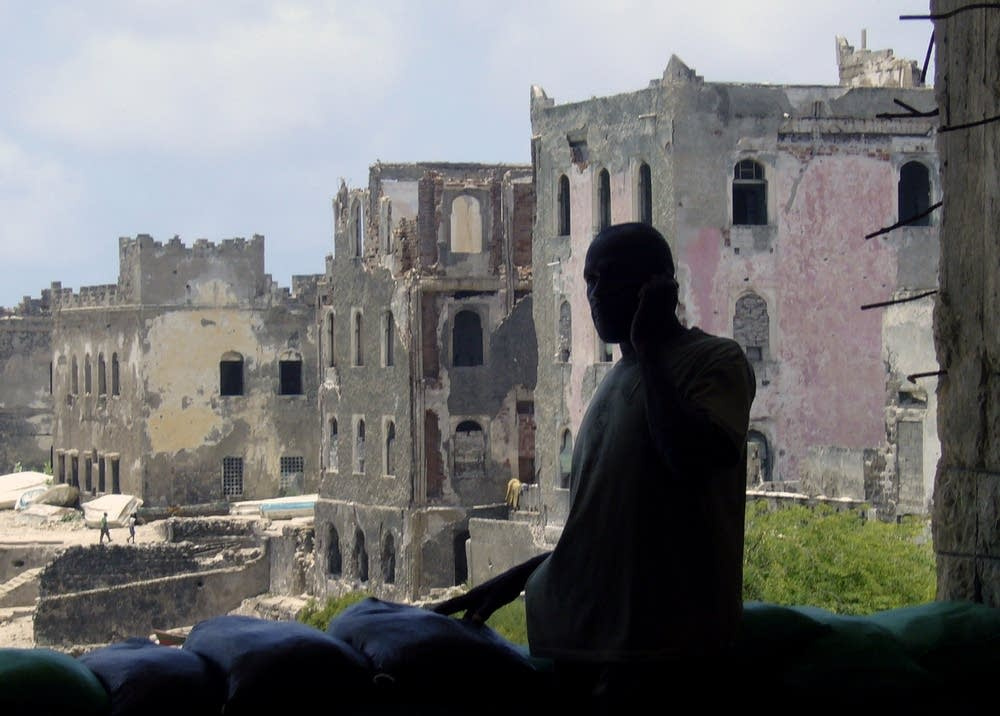
Quoting Wikipedia:
Yusuf Ahmed Sarinle was a general and, at the time of his death, the top security official of the embattled government of Somalia, functioning as the police chief of Mogadishu during the Somali Civil War. […] A few days before his murder, an Italian colonial cemetery had been destroyed by militiamen, and Sarinle had been investigating the incident. According to Egyptian newspaper Al-Ahram, "Sarinle was strongly opposed to militant Islamists, and many believe that Islamists were behind his cold-blooded murder." [Emphasis added]
Quoting Salad Duhul of the Arab News:
The governor [of Banadir, Abdullah Hassan Firimbi] said the criminals have just showed that they want to ruin the relations between the new Somali government and Italy. "This new government needs financial help from the Italian government. We know that certain people who oppose the new government want the Italian government not to help Somalia. Those criminals do not want the government to succeed. We hope that the desecration will not harm relations between Somalia and Italy," he said.
The Italian ambassador to Somalia, Francesco Lanata, deceased in 2018, provided the BBC with a significantly different explanation as to why the cemetery was destroyed:
"Initially it was an opportunistic land seizure. Land in Mogadishu is going up in value by the day because the government is due to return soon… International outrage after the attack changed its significance, Mr Lanata said. "They realised that, as well as being land on which they could build, it could be used for political and religious reasons," he said. "It can be an act against the Somali government - showing it has no influence on Somali affairs." Those who control the site say they are building a mosque there.
The problem with pessimism is that it makes optimists of us all.
This is a short video (under three minutes long) reflecting on the extent to which internet censorship (on Google and Google-owned platforms) has actually gotten worse and worse, during a period of time in which it has been perceived to be getting better… because of this paradoxical problem of past pessimism making us unduly optimistic in the present tense.
Friday, 19 December 2025
The New Left is Neither New Nor Left: the New Right is Neither New Nor Right.
The first livestream of season three.
Unusually, this was uploaded with two titles and two thumbnails (although the live performance had neither a title nor a thumbnail at all, I note: these embellishments were added on December 21st).